FIELD NOTES — TERRAIN
Soft snow and taller land
Snow on Fabriore's mountains used to stop at one height, like a tide mark. On new worlds it thins out down the slope in patches. And a world can now be made taller before the rain and the rivers get to it, so everything they shape fits the new heights.
Two changes to the world generator today, both about mountains. The first is small and shows on every new world: the snow line. The second changes nothing on the world you play on now, but decides how tall the next ones can be, and what that costs.
The pictures are of the same island as in One seed, one world, seed ksdyfnwt, taken in the game at three in the afternoon.
A snow line that fades
Once the land has its shape, the generator decides what every point of the map is: forest, meadow, bare rock, snow. Snow was one of the simplest rules. Above a certain height a point is snow, or glacier where it is coldest. Cold mountain tops a little lower get snow too, decided by temperature. Below those lines, never.
That drew a level edge around the mountain, like a tide mark. The ground textures softened it a little, because their own snow layer already blends in gradually on cold, high ground and comes lower on shaded slopes. But under the textures the biome still stopped dead at one height, and the biome decides more than the look. It also decides where trees may grow, and they never grow on snow.
Now every point below the line gets its own depth. A second noise field, ten times finer than the one that shapes the mountains, gives every point a number between 0 and 1. Where it is 1, the snow stops at the line as before. Where it is 0, the snow comes down 21 meters further. Close under the line almost everything is snow, with bare holes in it. Further down only the lowest spots of the noise are left, as patches that get smaller and sparser until they run out. The same fade applies to the cold mountain tops. Cliffs stay bare: the generator decides steepness first, and snow does not settle on a cliff.
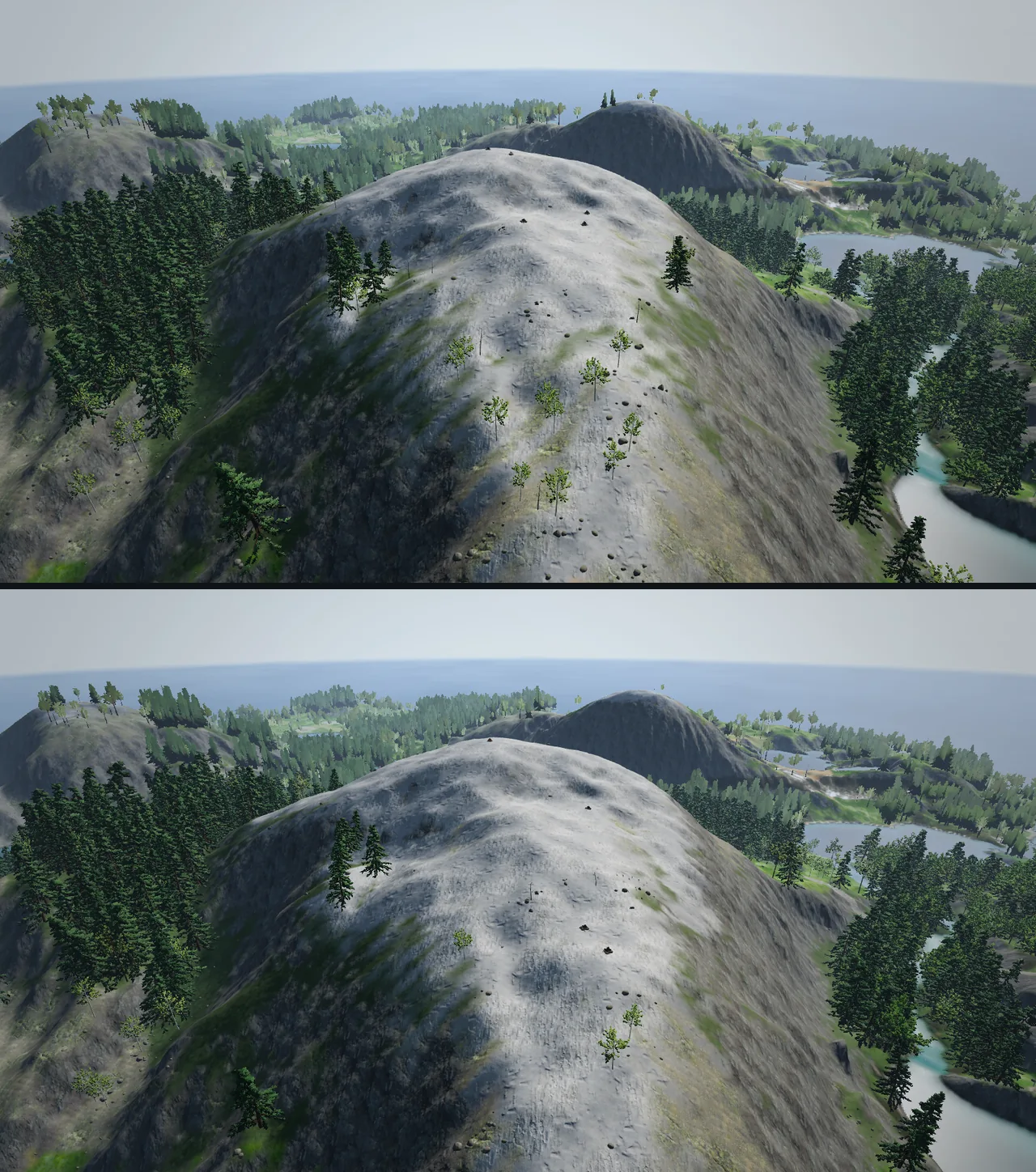
FIG. 1 — The island's highest summit from the north, from 185 meters above the sea. Top: before. Bottom: today. The snow now comes down the near face, and the small trees that stood below the old line are gone, because trees never grow on snow.
On this island the lowest snow came down from 112 to 91 meters, and the snow biome now covers 1.2 percent of the land instead of 0.49, nearly two and a half times as much. Most of the new snow lies above the tree line, which starts thinning out at 92 meters, so only 22 of the island's 16,324 trees gave way to it.
Taller land, shaped after it grows
Fabriore's mountains are not very tall. On this island the highest peak stands 131 meters above the sea. The generator now has a height factor: one number that multiplies every point's height above the sea, so 1.4 makes the land forty percent taller and the sea floor forty percent deeper.
Where it runs matters more than the number. There was a height factor before, but it was applied last, to the finished heights, so everything the generator had decided on the lower land was stretched with it. At 1.4 times, a road cutting graded at one in one and a half came out at nearly one in one. River banks shaped to stay under about 30 degrees came out at nearly 40. The gullies the rain had cut for 131-meter hills stood forty percent deeper. And the snow stayed on the ground it had been given, so the snow line rose with it, from 112 meters to about 157. A taller world made that way was a stretched world.
The factor now runs straight after the noise, before anything else has looked at the land. The raindrops of the erosion pass roll down the taller slopes and cut gullies to match. The biome rules see the real heights and the real steepness, and temperature falls with the real height, so the snow line stays where it belongs and more land rises above it. Rivers and lakes find their courses on the new land, and the roads are routed around its steeper ground and graded into it.
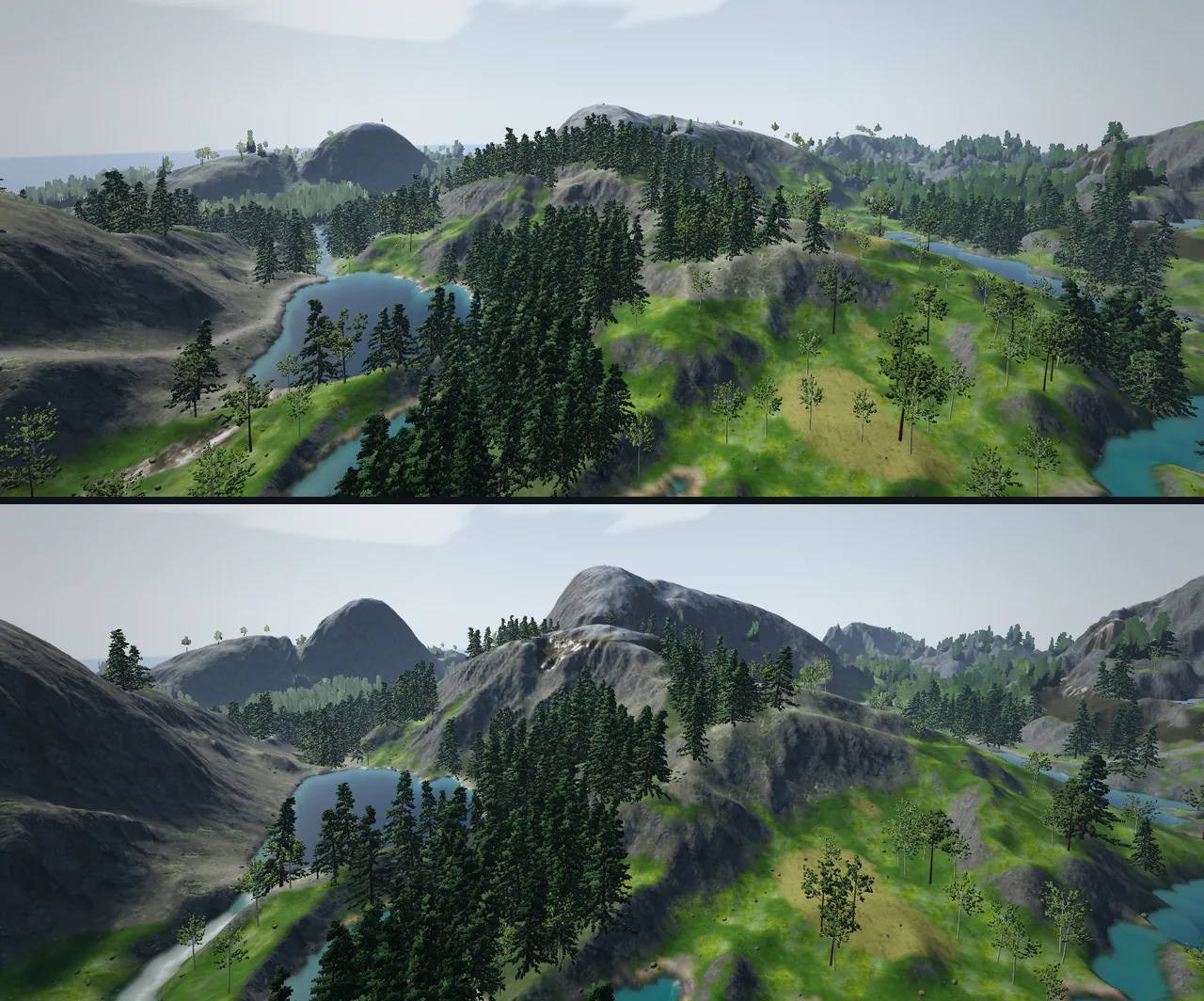
FIG. 2 — Looking west, from the same point 110 meters above the sea. Top: the island as the generator makes it today. Bottom: the same seed with a height factor of 1.4, a test world we have not released. The peaks rise, the rock faces grow, and the forest thins on the higher ground.
Here is what the taller test world changes, on the same seed:
- The highest peak rises from 131 to 181 meters.
- Land more than 100 meters above the sea grows from 1.5 to 5.3 percent of the island.
- Cliff grows from 13 to 21 percent of the land.
- The snow biome grows from 1.2 to 2.3 percent of the land.
- Trees fall from 16,302 to 12,713.
- Buildable land falls from 48.6 to 38.8 percent of the land's tiles.
That last line is the catch. Taller land is not free in a factory game. The factor steepens every slope along with the mountains, the gentle ones too, and flat ground is what you build on: at 1.4 times the island has a fifth less of it. Which height the next world gets is still open.
When you will see it
The soft snow line is a generator change, so it arrives the way every generator change does before launch. When this update reaches a server, the server makes a new world from the same seed with the new generator and switches to it. The old world keeps its file, untouched, and saves start over. That new world keeps today's height. Taller land is something a future world can be given.
What is still rough
The patches follow noise, not weather. Real snow lies longest in hollows and on the shaded side, and the wind strips it off ridges. Ours lies wherever the noise is low. The ground textures' own snow already prefers shaded slopes, but the biome under it does not.
While taking these pictures we also found a texture bug. On the taller test world, a few dry slopes below high lakes wear the lake-bed texture in sharp-edged blocks. The bug is in how the ground textures find the nearest water, not in the height factor; taller land just puts more dry ground below the level of its lakes. It is written up to fix.